Showing posts with label Strength training. Show all posts
Friday, April 15, 2016
Practical Uses of Variety in Training
A lot of my readers have been asking me about programming. This week, I was luck enough to have my friend Steve write a guest post for me. Steve Bare is a professional strength coach (CSCS, USAW) and competitive weightlifter. His experience includes work in the private industry and an internship at the Olympic Training Center in Chula Vista, California. He now coaches at a high school, where he is thankful to work with a huge number of adolescent athletes, and give them all a great start in strength training. You can occasionally catch him writing on his coaching blog, BareStrength.
Friday, March 4, 2016
Changing up Your Rep Scheme
If you seek out nearly any fitness-related website for information regarding rep schemes, you'll see something like this:
- For size, do 3-4 sets of 8-12 repetitions
- For strength, do multiple sets of 5 of fewer repetitions at a heavy weight
- For muscular endurance, do sets of 20 or more repetitions
While this is, generally satisfactory advice, I want to delve a little bit more into this topic.
First of all, genetics play a big factor in hypertrophy (muscle growth). Everyone responds differently to certain types of training. Every person has a different distribution of type I (slow twitch) and type IIa/b (fast twitch) fibers. Renowned strength coach Charles Poliquin notes, for example:
"It should be noted that the triceps are more universally fast-twitch dominant, while there is more variation in fiber-type composition in the biceps. This example demonstrates why training programs should take each individual’s personal characteristics into consideration. This is true in terms of both exercise selection and especially the volume and intensity of the workload, since individuals and specific muscles that are either fast-twitch or slow-twitch dominant will respond differently to a given level of volume and intensity. Understanding what you are dealing with will make your training programs significantly more effective."Put simply, if someone has more fast twitch fibers in a given muscle, then he may need to train a bit differently than an individual with a higher percentage of slow twitch fibers in that muscle. Muscles with a greater percentage of fast twitch fibers benefit from fewer repetitions per set, whereas muscles that are predominantly slow twitch will grow easier with the use of high volume. This also means that there's a great deal of variance in the ideal amount of repetition volume depending on what body part you're training.
While 8-12 repetitions will help build mass, it's certainly not the only method. In fact, it's ideal to change up your split if you've hit a plateau.
![]() |
| If you're gonna bench press to failure, just please, don't follow his example. |
You can also utilize this concept for muscular hypertrophy. "Recent studies have pointed muscular failure to be an important factor in order to maximize adaptations when RT is done at low intensities (LI-RT), " continued Nóbrega and Libardi. Try to use really light weights on your next set of biceps curls and go until you can no lift the dumbbells.
Additionally, while many "fitness gurus" have deemed high repetition sets as inefficient for muscle growth, research has shown that extremely high repetition training is, indeed effective for muscle growth. The conventional understanding is that sets of 20 repetitions or more are to be used for endurance of the muscle. Schoenfeld et. al. showed us, in his 2015 study, that 25-35 rep sets can work just as well as the traditional 8-12 rep sets we all know and love.
Schoenfeld drafted 24 experienced male trainees for his research. "Training was performed 3 times per week on nonconsecutive days, for a total of 8 weeks. Both [high load] and [low load] conditions produced significant increases in thickness of the elbow flexors (biceps), elbow extensors (triceps), and quadriceps femoris (9.3 vs. 9.5%, respectively), with no significant differences noted between groups." While this study defies the industry standard, it demonstrates that you can utilize many different intensities and volumes to elicit the same training effect.
Finally, I want to talk about sets. Most programs seem to cling to the magical 3-4 range. Every once in a while, you can try 5 or more sets. Why stop there? Sometimes I'll even do 10 sets of 10 (100 total reps) of a given movement. This is a great way to increase total workout volume and stimulate hypertrophy. You don't necessarily need to do 10 sets of every single accessory exercise, because you'd spend a full day in the gym, but it's a great way to finish off an intense session.
Friday, October 2, 2015
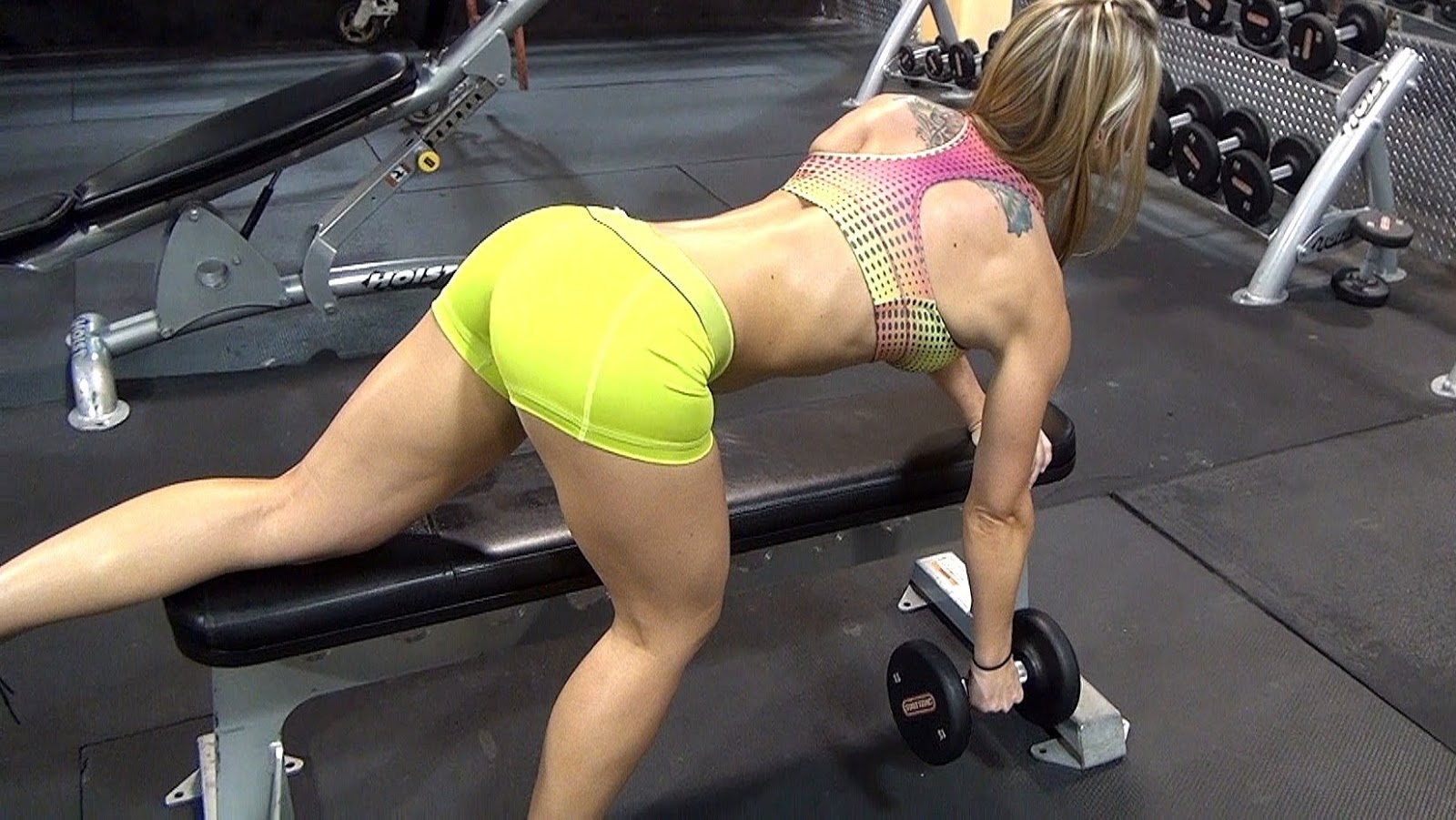
Revamping the Dumbbell Row
Rowing movements, like the dumbbell row or the kettlebell row, are a staple in any weight training or bodybuilding program. In fact, I would venture to say that a well-developed back is a fantastic indicator of overall strength and athleticism.
When you implement these movements into your routine, you want to make sure you're getting the most bang for your buck. If you execute a dumbbell row correctly, it is an excellent exercise for improving grip strength, shoulder stability, posture, and it can also advance your other big lifts like the bench press and the deadlift!
Two of the biggest blunders I notice most on this movement are the following:
![]() |
| Check out the position of her supporting arm. Don't do that. |
- Scapular retraction of the supporting arm. I mentioned this same concept on my post about perfecting the plank. Scapular retraction (when you pull the shoulder blades back), is a significantly less secure position than either scapular protraction (pushing the shoulders forward), or maintaining a neutral position somewhere in the middle. If you can see your entire shoulder blade, you're pulling from an unstable foundation.
- Kipping as you pull. Kipping is great for those who want to lift the most weight (for their own ego boosters), or individuals who are mostly focused on achieving more reps per set, but if you want to utilize the powerful latissimus dorsi muscles to their capacity, you're better off without it. If your main goal is strength, use a lighter weight, or do as many repetitions as you can perform with strict technique.
While the dumbbell row might seem like a pretty simple exercise, there are a lot of little nuances involved to achieve maximal contraction of the prime movers. Make these two easy fixes, and your friends and family will look at you and say "baby got back!"
Thursday, February 19, 2015
Training Simple for Maximum Results
There is a seemingly infinite list of exercises to work any given muscle group. With websites like YouTube, it's pretty easy to find new exercises on the internet and feel inclined to add them into your routine. The question, however, is are these circus tricks necessary to take your performance to the next level? When it comes to adding in movements to your routine, I believe less really is more.
Just when I think I've seen it all, I find some crazy new movement on Instagram or some other form of social media. While these exercises range from impressive to asinine, many of them are unnecessary when developing a program for yourself or others.
There's a lovely acronym in the fitness industry that is applicable here:
This principle explains simply that our bodies will adapt to the stressors to which are exposed. Therefore, if I want to become a better sprinter, well, adding some more sprinting drills into my regimen is a great starting point.
Personally, I train to compete in the sport of Olympic weightlifting. In order to get better in my sport, the bulk of my training consists of variations of snatches, cleans, jerks, presses and squats. Every once in a while, I'll add in accessory movements based on any imbalances or weaknesses. I rarely do conditioning, because it isn't really necessary for me to become a better weightlifter.
While you may not be looking to compete in a sport, it's important for you to set out your intentions from the get-go. You want to set realistic, quantifiable goals for yourself, and then select your exercises based on those goals. For example, if you want to bench 400 lbs, set your weekly workout routine around the bench press. Bench more regularly, and maybe include other, similar movements in your routine that will hit the same muscle groups (e.g. dips and strict press).
The more exercises you add into your weekly routine, the more overwhelmed you'll feel, and the less attention you'll pay to each movement! If you do 10+ exercises per day for the same muscle group, you're missing out on your ability to focus on any one of them.
Exercise variety does not determine your results. Doing 20 exercises for a muscle group will not necessarily make your muscles grow any quicker than doing 3 exercises for a muscle group. What does determine hypertrophy (muscular growth) is intensity (or weight used) and volume (number of reps performed). Basically, you only need to do a lot of reps of a few exercises to see results!
To apply this to sports, you must first analyze the demands of your specific sport. If you are a tennis player, which primarily takes place in the frontal plane, you want to make sure that a big part of your program involves lateral movements. Lateral lunges, lateral jumps and shuffling drills are all important exercises for tennis. Sprints on the rowing machine will certainly get your heart rate up, but they won't necessarily improve your forehand. Your exercise choices should mimic the demands of the game.
I'm certainly not telling you that you shouldn't try new exercises, as you may find a fun, creative new movement that helps you improve your weak areas. Instead, I believe you should find a handful of exercises that are directly beneficial to you and that will help you achieve your goals in the gym; everything else is frivolous.
Just when I think I've seen it all, I find some crazy new movement on Instagram or some other form of social media. While these exercises range from impressive to asinine, many of them are unnecessary when developing a program for yourself or others.
There's a lovely acronym in the fitness industry that is applicable here:
SAID: Specific Adaptation to Imposed Demands
This principle explains simply that our bodies will adapt to the stressors to which are exposed. Therefore, if I want to become a better sprinter, well, adding some more sprinting drills into my regimen is a great starting point.
![]() |
| This may come as a surprise, but these will not make you a better squatter. |
While you may not be looking to compete in a sport, it's important for you to set out your intentions from the get-go. You want to set realistic, quantifiable goals for yourself, and then select your exercises based on those goals. For example, if you want to bench 400 lbs, set your weekly workout routine around the bench press. Bench more regularly, and maybe include other, similar movements in your routine that will hit the same muscle groups (e.g. dips and strict press).
The more exercises you add into your weekly routine, the more overwhelmed you'll feel, and the less attention you'll pay to each movement! If you do 10+ exercises per day for the same muscle group, you're missing out on your ability to focus on any one of them.
Exercise variety does not determine your results. Doing 20 exercises for a muscle group will not necessarily make your muscles grow any quicker than doing 3 exercises for a muscle group. What does determine hypertrophy (muscular growth) is intensity (or weight used) and volume (number of reps performed). Basically, you only need to do a lot of reps of a few exercises to see results!
To apply this to sports, you must first analyze the demands of your specific sport. If you are a tennis player, which primarily takes place in the frontal plane, you want to make sure that a big part of your program involves lateral movements. Lateral lunges, lateral jumps and shuffling drills are all important exercises for tennis. Sprints on the rowing machine will certainly get your heart rate up, but they won't necessarily improve your forehand. Your exercise choices should mimic the demands of the game.
I'm certainly not telling you that you shouldn't try new exercises, as you may find a fun, creative new movement that helps you improve your weak areas. Instead, I believe you should find a handful of exercises that are directly beneficial to you and that will help you achieve your goals in the gym; everything else is frivolous.
Sunday, September 28, 2014
The Biggest Mistake You're Making in the Gym
When you walk into any fitness center, where do you see the most people? Most likely they're all crowded around the treadmills, stationary bikes and ellipticals. The common misconception is that you can achieve the body that you want and get in great shape by spending half an hour to an hour doing "cardio."
If you want a more shredded and resilient physique, though, then you need to do the following: interval training and weight training. That's it. That's the secret sauce. Someone who is "fit" should be ready to take on any task at hand. He should be fast, strong, and powerful. Fitness is reading Game of Thrones on the elliptical for forty five minutes.
Day after day, thousands of people slave away on the cardio machines, many of whom are watching Gossip Girls or reading a book.
Look, as long as you're getting your butt off of the couch, I'm happy for you. Really. My goal, however, is to help you maximize your time in the gym. If you are one of these people who fits the description above, I'm willing to bet you haven't really seen the results you've wanted.
I'm not really a fan of steady-state cardio sessions. If you like to go for a long run every once in a while, that's great, but it shouldn't be the only thing you're doing in the gym.
![]() |
| Don't be like these guys... |
Interval training is one of the most effective ways to build lean body mass and improve your overall athleticism. There are countless different types of intervals, but here are some suggestions (you can do these with any activity, whether it be rowing, burpees, running, etc.):
- 10 rounds of 30 seconds on, 30 seconds off (work up to decreasing the rest time as you improve)
- 4 rounds of 1 minute of work, 2 minutes of rest
- 8 rounds of 20 seconds of work, followed by 10 seconds of rest (called a "Tabata" interval)
These are a few of my favorites.
Strength training is important and necessary for...everyone. Yep. I've said it before, and I'll say it again. Everyone should get stronger. Besides, being strong is awesome.
Let's say you're moving into a new apartment, and you need to move heavy boxes up the stairs. Strength training will prepare you for damn near everything. I can't really think of one situation in which being stronger isn't helpful.
You're not only strengthening your muscles with weight training, though--you're also strengthening your tendons, your bones and your ligaments, making you more resilient. If you want to avoid broken bones and osteoporosis (which I imagine you would), then you need to lift weights.
I'm certainly not telling you to quit your steady state cardio. I know that some people love a leisurely run. I think a great program is one that makes you well-rounded. If you want to become fitter and more resilient, then strength training and sprints should be a part of your regular routine. Step off of the elliptical and pick up some dumbbells.
Tuesday, July 29, 2014
Strength Training for Women: Lift Weights for the Body You Want
Every single woman should lift weights. Yes, every one of them. I don't care if you're 14 or 72, you can still benefit from strength training.
The media has condemned strength training for women for years, saying that lifting heavy weights will make you appear "bulky" or manly, and that is 100% false. Some women seem to think that a dumbbell heavier than 5 pounds will give them magical giant biceps that appear overnight. I've heard so many celebrity fitness trainers perpetuate this myth and say that women are better off lifting really light weight for more repetitions to "tone" their muscles. First of all, the word "tone" does not mean anything. Our muscles either grow (hypertrophy) or deteriorate (atrophy). We can lose body fat to make those muscle more apparent, but we can't "tone." Lifting light weights for a lot of repetitions will not make you stronger or more toned, so you are effectively wasting your time. There, I said it. If you want to make the most out of your time in the gym, you need to lift heavier weights. Our bodies need to adapt to a stimulus. If we are doing the same exercise everyday (i.e. going on the elliptical for 30 minutes, and then doing 15 minutes of crunches and light dumbbell exercises), our bodies will never adapt.
I can promise you that in my two years of strength training so far, I have never been mistaken for a man!
Now that that's out of the way, strength training has tremendous benefits, specifically for women, who already have less muscle mass than men.
Those with more muscle mass burn more energy (calories) at rest. Yes, you read that correctly. If you have more muscle, you can eat more, because your body simply needs more calories to sustain this extra muscle tissue. "Each day, your body uses more than 35 calories to maintain each pound of muscle, while only 2 calories are needed to sustain a pound of fat (Westcott and Baechle 1998)."
Not only will you burn more calories in the course of the day, it has been proven in several studies (see sources below) that individuals with a higher lean body mass live longer, healthier lives. Strength training obviously makes your muscles stronger, but many fail to realize that lifting weights also strengthens our bones, tendons and our ligaments. If you want to avoid degeneration of your bones (osteoporosis) and connective tissue injuries later in life, strength training is extremely important. "Osteoporosis is partially preventable with adequate amounts of calcium in the diet, along with progressive high-intensity resistance training (Graves and Franklin 2001)." For women who are pre or postmenopausal, strength training is especially important to prevent further loss of muscle tissue.
In addition to the physiological benefits, there are many psychological benefits. Personally, I've proved to myself that I am capable of so much more than I realized. I recently set a deadlift personal record at 275 lbs (2 times my own bodyweight). I never would've dreamed of lifting that much weight. I know too many women who are unable to perform a push-up or a pull-up without assistance, which I believe are two movements everyone should be able to do.
Being a woman is not an excuse for being weak! Step out of your comfort zone and try something new. Make sure you have a friend with you who can make sure you are moving correctly. I promise you, you won't regret it!
Subscribe to:
Posts (Atom)